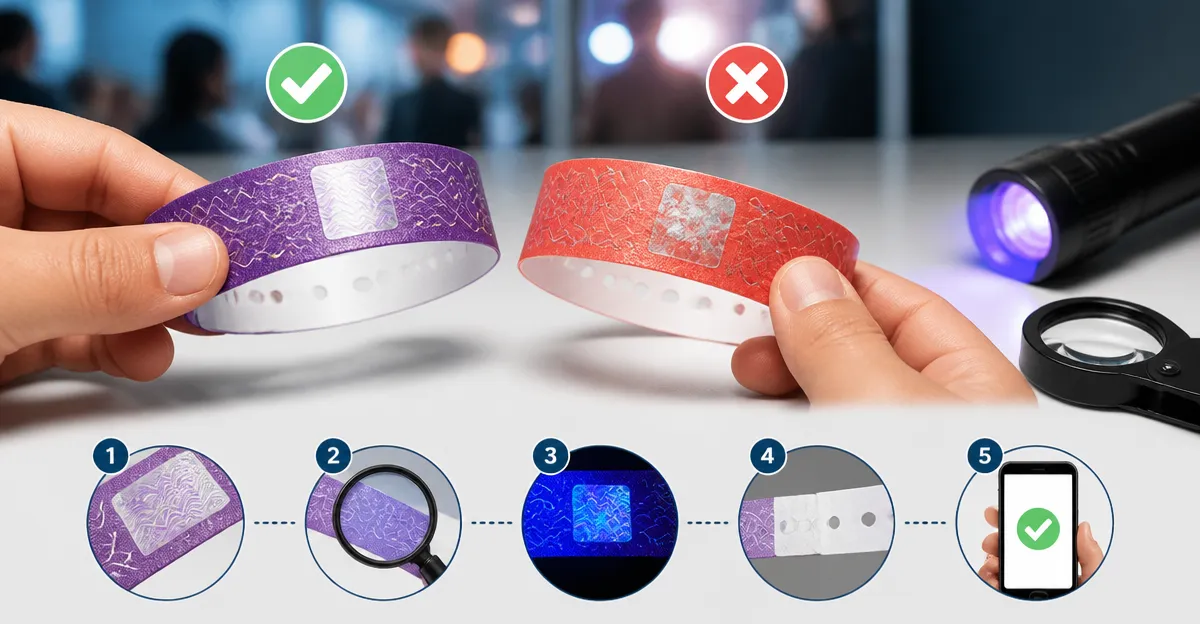
How to Detect Counterfeit Event Wristbands: A Step-by-Step Guide to Spot Fakes and Prevent Fraud
Introduction
Event organizers, security personnel, and venue managers constantly confront the risk of counterfeit wristbands infiltrating their admission systems. This guide explains how to identify fraudulent wristbands, protect revenue, and maintain a safe environment for attendees. Readers will learn practical inspection techniques, the role of tamper‑proof features, and how to use reliable tools to verify authenticity. By following the steps, one can reduce the likelihood of unauthorized entry and preserve the reputation of the event.
What You’ll Need
- A reference set of genuine wristbands for visual comparison.
- Magnifying glass or handheld loupe (10× or higher).
- Fine‑point permanent marker for testing tamper‑evidence.
- UV flashlight (optional) to examine hidden security inks.
- Documentation tools such as a clipboard, pen, and a digital camera.
- Recommended products for reference and testing (see step sections).
Step 1: Verify Official Branding
The first visual cue is the branding printed on the band. Authentic WristCo products display crisp, high‑resolution logos and text that align with the brand’s style guide. Compare the event logo, color palette, and font to a known genuine sample. If the print appears faded, pixelated, or misaligned, the band may be counterfeit.
Using a set of Neon Green Tyvek Wristbands as a reference sample provides a reliable benchmark. These bands are made from DuPont Tyvek, offering a dense fiber structure that resists tearing. Priced at $8.88 for 600 pieces, they hold a 4.8‑star rating from over 2,000 reviews, indicating consistent quality. Their neon color makes visual comparison straightforward under most lighting conditions.
The advantage of using an official WristCo band is that it contains the exact adhesive closure and die‑cut pattern found on authentic products. Alternatives such as generic plastic bands lack these security features, making the Neon Green sample the most effective reference.
Step 2: Examine Material and Texture
Tyvek is a high‑density polyethylene (HDPE) fabric that feels softer than paper and smoother than thin plastic. Run a fingertip across the band; genuine Tyvek should glide without catching, and the edge should feel cloth‑like rather than sharp. Counterfeit bands often use low‑grade paper or PVC, which can cause paper cuts or feel brittle.
The 6-Color Tyvek Wristbands pack offers a variety of colors that enable tactile testing across multiple hues. Each pack contains 600 bands at $8.88, with the same 4.8‑star rating as the Neon Green version. The multi‑color selection helps verify that the material consistency is uniform regardless of shade, a characteristic of genuine Tyvek production.
Choosing Tyvek over cheaper alternatives reduces the risk of accidental injuries and ensures durability throughout a multi‑day event. The 6‑Color pack also serves as a visual aid for color‑coding access levels, a common practice in large festivals.
Step 3: Test the Tamper‑Proof Closure
WristCo incorporates a security die‑cut into the adhesive closure, creating a tamper‑evident seal that can only be removed by destroying the band. To test this, gently pull the band apart at the closure point. A genuine band will resist separation and, if forced, will tear at the die‑cut, leaving a clear indication of tampering.
For a hands‑on demonstration, use the Custom Tyvek Wristbands. Although priced higher at $13.69 for a customizable batch, they retain the same tamper‑proof technology and have a 4.7‑star rating from 1,519 reviewers. Customization allows organizers to imprint event‑specific graphics, making it easier to spot any deviation in the closure pattern.
The benefit of using a customizable band is twofold: it provides a unique visual identifier for your event and reinforces the tamper‑proof feature with a personalized design. Competing products lacking this closure are more susceptible to reuse and fraud.
Step 4: Verify Sequential Numbering and Perforation
Many events assign sequential numbers to wristbands for authentication and crowd monitoring. Authentic WristCo bands are perforated in groups of ten, enabling staff to separate sheets quickly. Examine the numbering font and spacing; genuine numbers are printed with fade‑resistant ink that remains legible under sunlight.
The 5-Color Variety Pack Tyvek Wristbands includes 1,000 bands at $13.88, rated 4.7 stars by 3,670 reviewers. This larger quantity is ideal for events that require extensive numbering, as the pack offers a broad color range for tiered access while preserving the same perforation system.
Using a bulk pack ensures that you have enough genuine, numbered bands to compare against incoming wristbands. Counterfeit batches often omit proper numbering or use inconsistent fonts, making discrepancies easy to spot when a reference pack is on hand.
Step 5: Conduct Light‑Based Authentication (Optional)
Some WristCo wristbands incorporate UV‑reactive inks that are invisible under normal lighting but glow under ultraviolet light. While this feature is not advertised for every product, many bulk orders include a hidden security stripe. Shine a UV flashlight on the band; authentic strips will emit a bright, consistent glow.
If your event requires an extra layer of security, consider purchasing the Neon Blue Tyvek Wristbands. At $18.88 for 1,200 pieces and a 4.8‑star rating from 110 reviewers, these bands combine high visibility with the same tamper‑proof closure. Their neon hue makes them especially suitable for outdoor festivals where UV testing can be performed in daylight.
The advantage of a UV‑responsive band is that it adds a covert verification step that counterfeiters rarely replicate. Alternatives such as plain paper bands lack any hidden security features, leaving them vulnerable to duplication.
Tips & Pro Tips
- Always keep a sealed sample of genuine wristbands in a secure location for quick reference.
- Train staff to recognize the feel of Tyvek and the sound of the tamper‑proof closure when snapped.
- Document any suspicious bands with photographs and serial numbers for follow‑up investigations.
- Consider using a portable barcode scanner if your wristbands include QR or barcode data.
- Rotate color schemes each season to prevent counterfeiters from reusing old templates.
Troubleshooting
Problem: The adhesive closure feels weak and separates easily.
Solution: Verify that the band is genuine Tyvek; counterfeit bands often use cheap adhesives that lose strength when exposed to humidity.
Problem: Serial numbers appear smudged or inconsistent.
Solution: Compare the font and spacing to a known authentic batch; replace any suspect bands with verified stock.
Conclusion
Detecting counterfeit event wristbands requires a systematic approach that examines branding, material, closure, numbering, and optional UV features. By using authentic WristCo samples as reference tools, staff can quickly identify fake bands and prevent unauthorized entry. Implementing the steps outlined in this guide will safeguard revenue, enhance attendee safety, and uphold the professionalism of any event.
Products Mentioned in This Guide
Frequently Asked Questions
How can I visually verify the authenticity of an event wristband?
Check branding, logo placement, color accuracy, print clarity, and the presence of tamper‑proof features like holograms or security inks.
What tools are essential for inspecting wristbands on site?
A magnifying glass or 10× loupe, a fine‑point permanent marker, a UV flashlight (optional), and documentation supplies such as a clipboard and camera.
How does a UV flashlight help detect fake wristbands?
It reveals hidden security inks or patterns that are invisible under normal light but appear under UV illumination.
What is the purpose of using a fine‑point permanent marker in the verification process?
Marking a discreet area tests tamper‑evidence; genuine wristbands resist smearing or removal, while fakes often show ink bleed or easy removal.
Why should I keep a reference set of genuine wristbands?
A genuine set provides a baseline for direct visual comparison, making it easier to spot discrepancies in counterfeit copies.