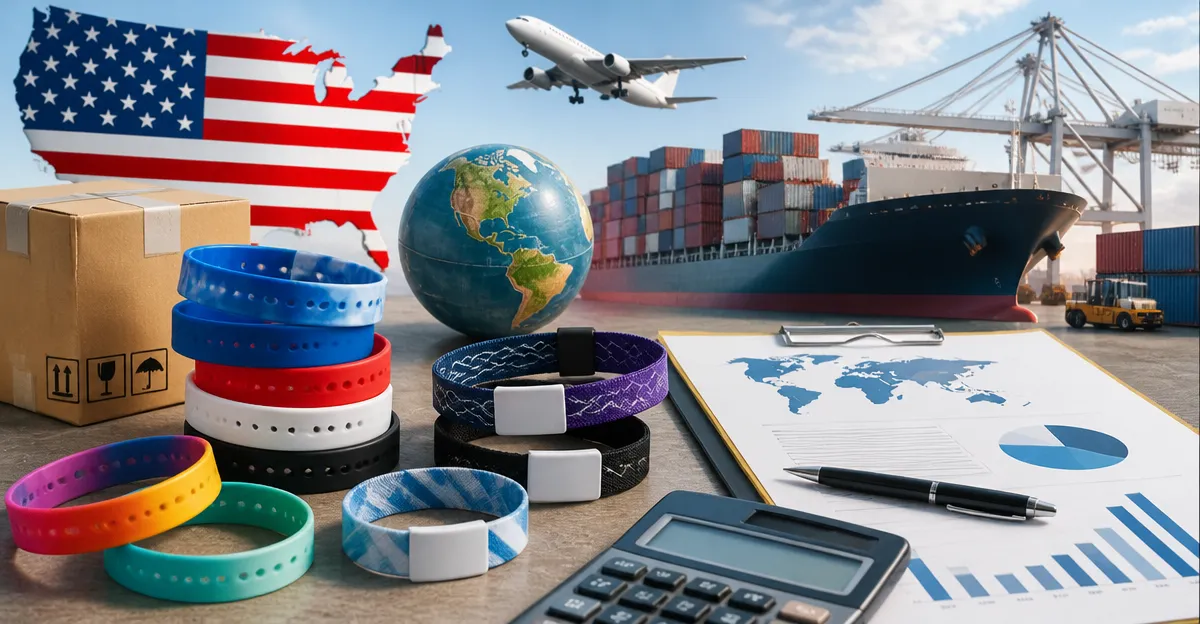
Importing Custom Wristbands into the USA: The Complete Guide to Duties, Customs Clearance, HS Codes & Costs
Introduction
This guide explains every critical step required to import custom wristbands into the United States. Readers will learn how to classify products with the correct HS code, estimate duty rates, navigate customs clearance, and evaluate total landed cost. In addition, the guide recommends five proven wristband solutions that illustrate how material choice influences duties and compliance.
By the end of the article, one will be able to create a reliable import plan, avoid common pitfalls, and select the most appropriate wristband type for a specific event or business need.
Background/Context
Custom wristbands are widely used for event admission, fundraising, brand promotion, and security tagging. The United States classifies wristbands under several tariff headings depending on material composition. Silicone, plastic, Tyvek, paper, and cloth each carry distinct HS codes, which directly affect duty percentages and documentation requirements.
Understanding the regulatory environment is essential because misclassification can lead to delayed shipments, fines, or additional duties. Importers must also consider the Consumer Product Safety Commission (CPSC) rules for skin‑contact items, especially regarding lead content and allergen warnings.
Understanding HS Codes and Duties
Harmonized System (HS) codes are six‑digit identifiers used worldwide to categorize goods. The United States expands these codes with additional digits to pinpoint exact product characteristics. The following table lists typical HS codes for wristband materials:
| Material | HS Code (US) | Typical Duty Rate |
|---|---|---|
| Silicone (rubber) | 4016.99.10 | 0% (most silicone accessories are duty‑free) |
| Plastic (PVC, PET) | 3919.10.00 | 2.5% – 5% |
| Tyvek (HDPE fabric) | 3926.90.99 | 0% – 2% |
| Paper (coated) | 4820.10.00 | 0% – 3% |
| Cloth (woven) | 6307.90.98 | 4% – 6% |
Importers should verify the exact sub‑heading with a customs broker, as duty rates may vary based on the country of origin and any applicable trade agreements.
Customs Clearance Process
After the goods arrive at a U.S. port, the following steps are required:
- File an Entry Summary (Form 7501) through the Automated Commercial Environment (ACE).
- Provide a Commercial Invoice that lists unit price, total value, HS code, and country of origin.
- Submit a Packing List and any required certificates (e.g., CPSC compliance for silicone).
- Pay assessed duties, taxes, and any Merchandise Processing Fee (MPF).
- Obtain release from Customs and Border Protection (CBP) before final delivery.
Using a licensed customs broker can streamline these steps, especially when handling large volumes such as the 10,000‑unit orders possible with Custom Silicone Wristbands.
Selecting the Right Wristband Material
The material you choose influences not only the aesthetic and durability of the product but also the HS classification, duty rate, and import documentation. Below are brief overviews of the five featured wristband types.
1. Silicone Wristbands
Silicone offers a waterproof, flexible, and hypoallergenic solution. The Custom Silicone Wristbands are 100% silicone, debossed with ink‑filled designs, and available in youth (7"), adult (8"), and large (8.5") sizes. With a 4.8‑star rating from 2,455 reviews and a price of $9.99 per unit, they are a cost‑effective choice for bulk fundraising campaigns.
2. Plastic Wristbands
Plastic bands such as the VIP Plastic Wristbands provide a rigid structure, a built‑in adjustable glue strip, and a vibrant printed surface. They measure approximately 9.84" long and 1.2" wide, fitting most adults. Priced at $15.99 for 500 pieces and rated 4.8 stars, they are ideal for high‑visibility events where durability under water or sweat is required.
3. Tyvek Wristbands
Tyvek is a breathable, waterproof HDPE fabric that feels like paper but resists tearing. The Tyvek Wristbands are 10" long, 0.75" wide, and feature a tamper‑proof die‑cut closure. At $13.69 per pack and a 4.7‑star rating, they excel in scenarios where counterfeit prevention and recyclability are priorities.
4. Paper Wristbands
For low‑cost, disposable identification, the Paper Wristbands come in mixed colors, 500 per pack, and are coated for waterproof performance. Priced at $8.99 and holding a 4.6‑star rating, they are perfect for large festivals that need quick color‑coding of attendee groups.
5. Cloth Wristbands
Cloth bands such as the VIP Cloth Wristbands combine comfort with a secure, disposable time lock. Each pack includes 100 black bands measuring 1.5" x 35" when unrolled, allowing adjustable fits. At $19.99 per pack and a 4.6‑star rating, they are suited for premium events where a premium feel is expected.
Comparison/Selection Guide
When choosing a wristband for import, consider the following criteria:
- Material & HS Code: Determines duty rate and required documentation.
- Quantity Needed: Bulk discounts often apply; silicone and plastic options support orders up to 10,000 units.
- Durability Requirements: Water parks demand waterproof materials (silicone, plastic, Tyvek).
- Security Features: Tyvek and cloth bands provide tamper‑proof closures, reducing fraud.
- Cost per Unit: Paper bands are the cheapest, while cloth bands are the most expensive.
Table 2 summarizes key attributes:
| Product | Material | HS Code | Duty % | Price per Unit | Key Strength |
|---|---|---|---|---|---|
| Custom Silicone Wristbands | Silicone | 4016.99.10 | 0% | $9.99 | Waterproof, hypoallergenic, bulk sizing |
| VIP Plastic Wristbands | Plastic | 3919.10.00 | 2.5‑5% | $0.032 (500 for $15.99) | Adjustable glue strip, vivid printing |
| Tyvek Wristbands | Tyvek (HDPE) | 3926.90.99 | 0‑2% | $13.69 | Tamper‑proof, recyclable |
| Paper Wristbands | Coated paper | 4820.10.00 | 0‑3% | $8.99 | Color‑coding, disposable |
| VIP Cloth Wristbands | Cloth | 6307.90.98 | 4‑6% | $19.99 | Comfortable, time‑lock security |
Best Practices & Tips
- Obtain a pre‑classification ruling from CBP when importing large volumes to avoid unexpected duties.
- Request a Certificate of Origin from the supplier; this can reduce duty rates under NAFTA/USMCA if the manufacturer is in Canada or Mexico.
- Include detailed product descriptions on the commercial invoice, specifying material, dimensions, and any special finishes (e.g., ink‑filled debossing for silicone).
- Consider using a freight forwarder with experience in low‑value, high‑volume shipments to consolidate costs.
- Maintain records for at least five years, as required by CBP for post‑entry audits.
FAQ
- What HS code should I use for silicone wristbands?
- Use 4016.99.10, which covers other rubber products not elsewhere specified. Verify with a broker if the bands contain additives.
- Are paper wristbands subject to CPSC regulations?
- Because they are disposable and do not contain metal components, they are generally exempt, but any printed inks must be lead‑free.
- Can I import 10,000 silicone wristbands in a single shipment?
- Yes, provided the commercial invoice accurately reflects the total value and the shipment complies with CBP packaging rules.
- Do Tyvek wristbands require a special import license?
- No specific license is required, but the importer must declare the correct HS code and ensure the adhesive closure complies with safety standards.
- How can I reduce duties on plastic wristbands?
- Source the plastic from a USMCA‑eligible country or negotiate a lower tariff classification if the product is considered a “promotional item” rather than a “plastic accessory.”
- What is the typical lead time for bulk orders?
- Most suppliers ship within 9‑10 days for silicone, while paper and plastic batches may be ready in 5‑7 days, depending on inventory.
Conclusion
Importing custom wristbands into the United States requires careful attention to HS classification, duty rates, and customs documentation. By selecting the appropriate material—whether silicone, plastic, Tyvek, paper, or cloth—importers can align product performance with cost efficiency. The featured products illustrate how each material impacts duties, durability, and security, enabling informed decisions for events, fundraising, or brand promotion.
Following the best practices outlined above will minimize clearance delays, control landed cost, and ensure compliance with all regulatory requirements.
Products Featured in This Guide
Custom Silicone Wristbands
Price: $9.99 Rating: 4.8/5 (2,455 reviews)
Featured because silicone offers a duty‑free classification, waterproof durability, and bulk quantity flexibility for large campaigns.
VIP Plastic Wristbands
Price: $15.99 Rating: 4.8/5 (1,079 reviews)
Featured for its adjustable glue strip, vibrant printing, and suitability for water‑intensive venues, despite a modest duty rate.
Tyvek Wristbands
Price: $13.69 Rating: 4.7/5 (1,554 reviews)
Featured because Tyvek’s recyclable nature and tamper‑proof closure provide security while maintaining a low duty percentage.
Paper Wristbands
Price: $8.99 Rating: 4.6/5 (616 reviews)
Featured for cost‑effective, color‑coded identification in large crowds, with a waterproof coating that meets outdoor event needs.
VIP Cloth Wristbands
Price: $19.99 Rating: 4.6/5 (131 reviews)
Featured for premium comfort, adjustable fit, and a disposable time lock that deters reuse, making it ideal for high‑value events.
Frequently Asked Questions
What HS code should I use for silicone custom wristbands when importing into the USA?
Silicone wristbands are typically classified under HS code 3917.10, which covers articles of plastics made of other polymers.
How can I estimate the duty rate for paper wristbands?
Paper wristbands fall under HS code 4820.10 and usually attract a duty rate of 0% to 5% depending on the trade agreement and value.
What documents are required for customs clearance of custom wristbands?
You need a commercial invoice, packing list, Bill of Lading, and the correct HS code declaration; a certificate of origin may be required for reduced duties.
Does the material of the wristband affect the total landed cost?
Yes, material determines the HS code, duty rate, and any special compliance fees, which together impact the landed cost.
Are there any common pitfalls to avoid when importing wristbands?
Common mistakes include misclassifying the material, under‑declaring value, and failing to provide required certificates, which can lead to delays or penalties.